
Let me start by stating, "My way is not the only way." I spent roughly a year reseaching the Internet on how to wash a fleece and figured out what worked best for me and what I had available to do it with. Washing Babydoll wool really isn't any different than washing any other breed's wool except it is not necessary to be so careful with agitation as it does not wet felt easily. There is a lot of opinions out there about what detergent is "safe" and what is going to ruin the wool. I use Dawn and Power Scour and haven't ruined a fleece to date and I've been doing this for over 10 years now. One thing to keep in mind is I card all my wool so I'm not concerned with keeping the cut ends together. If it is something you're wanting to do, then you'll need to adjust how you pick and scour your fleece to keep the locks aligned and in the correct direction. Do some Internet research.
My steps:
1. Shearing - Your sheep need to be sheared. Whomever is shearing them should be made aware of your plan to process the wool. A good shearer will remove the belly, leg, face, and head wool during the shearing process and avoid second cuts. Depending upon you and your sheep, you can wash the sheep prior to sheering to remove a lot of dirt and VM. Make sure they are dry before shearing. You could also use a blower to blow out dirt and some of the VM before shearing.
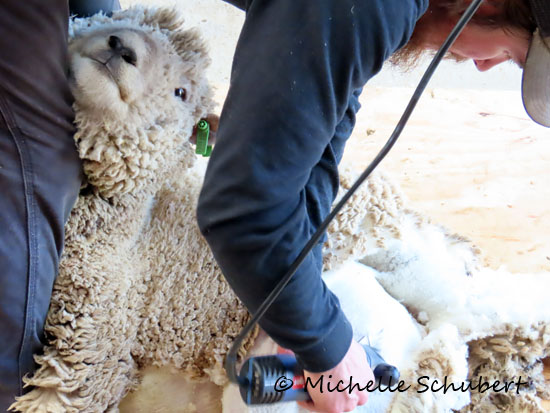
Baldwin getting sheared
The photos are of me processing Baldwin's wool in 2020 in my kitchen sink. Since then I moved and now use 5-gallon buckets in my pet bath sink I have in my laundry room which is closer to the water heater. I've had a septic system and city sewer system. I've not had any problems with either just letting the water go down the sink drain. If you prefer, you can make sure you use containers you are able to empty outside in your yard.

2. Skirting - I sit outside if the weather is nice. If not, I put a large flat sheet down and work over it. I remove the obvious locks with manure or urine on them. It is also important to remove the greasy wool from around and under the tail and along the belly referred to as "wool tags" or "sweat locks". All of the skirtings can be used in a garden. Then I pick out pieces of grass, hay, straw, and bugs - yes! I've found beetles and ticks while skirting. This is known as vegetable matter (VM). NOTE: I do not remove the britch wool as many quides will instruct you to do. This is the wool at the lower thigh area of the sheep, near the tail, and is generally coarser than the rest of the sheep's wool. I find many of my Babydoll's britch wool is totally usable. IF the wool doesn't feel super course, I keep it and mix it in with the rest of the wool.
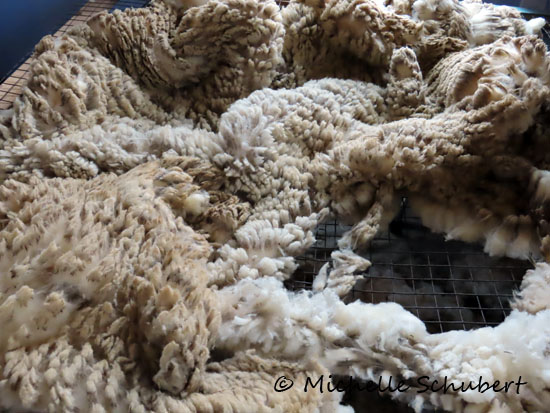
Skirting Baldwin's fleece
3. Picking - After the skirting, I hand-pick the fleece. For this step, I literally pick up a handful at a time, give it a good shake, and pick out more of the VM. I fill a 5-gallon bucket roughly 2/3rds of the way full and work with that much at a time. My back won't let me do more and I feel it is a good amount to not let yourself feel overwhelmed.
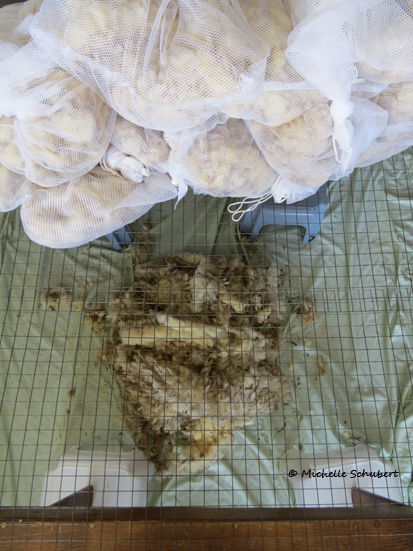
VM picked, ready for washing
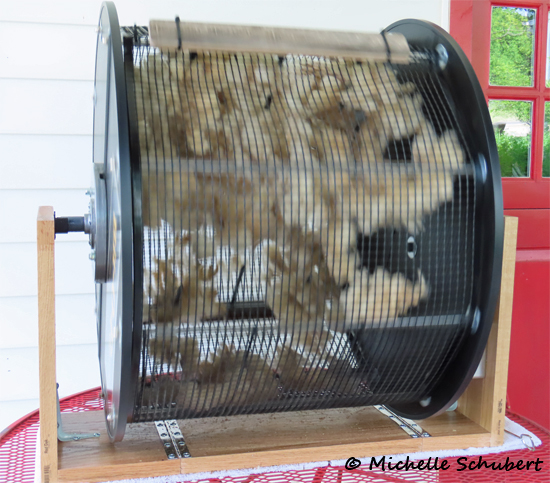
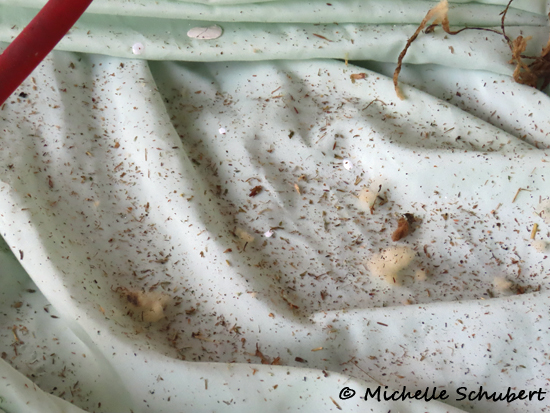
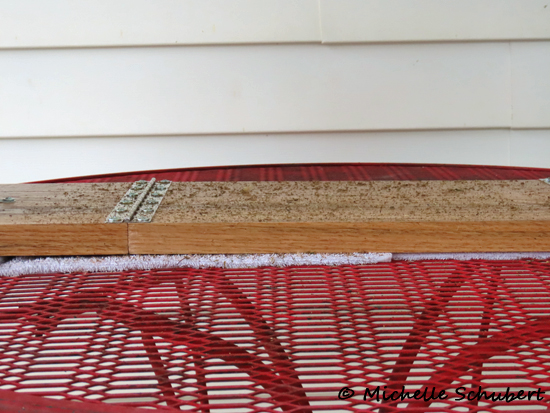
Since writing this how to: My newest wool processing acquisition is a tumbler. How did I work without it? If you don't have one, the step above works. But now, I simply shake the wool and put it in the Bit-O-Flufftumbler made by Alpaca Rosa. After tumbling it for an hour, I scour the fleece. The second two photos are an example of how much VM comes out of the fleece. Keep in mind this is just 2/3rds of a bucket of fleece.
Some like to work with wool that has a bit of lanolin in it. IF you are planning on sending your scoured wool to a mill for further processing, ALL lanolin must be removed.
4. Washing - First I soak the wool in plain hot water for roughly 20 minutes. Then I rinse it, by the handful, under running hot water. The water is as hot as my hands can stand and I don't wear gloves. One probably should though to protect against infection from fecal matter or other nasties. Absolutely, do make sure you are up-to-date on your Tetanus vaccine.
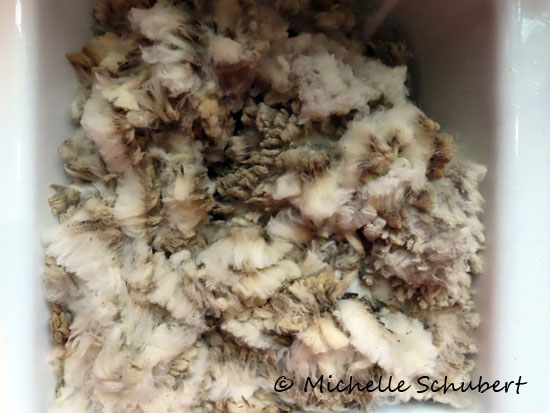
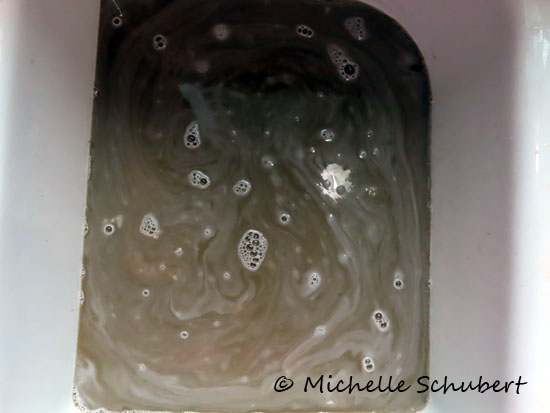
Getting ready to rinse with hot water / The water after the 1st rinse
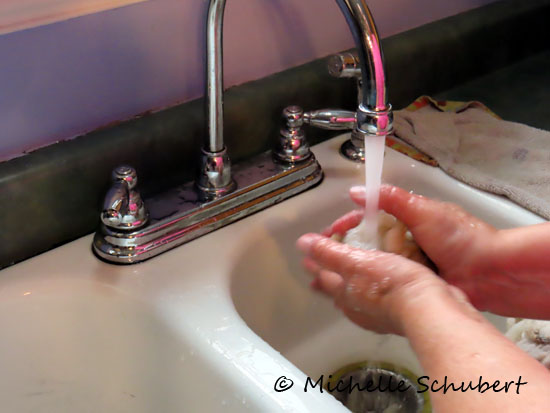
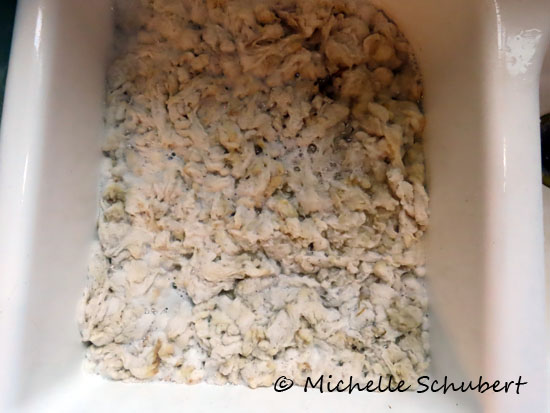
Rinsing
the fleece under the faucet after the soak / Soaking in Dawn
5. Scouring - The
process of removing the dirt plus all the lanolin/oils for a squeaky
clean fleece for dyeing or further processing. As opposed
to WASHING which is the process
of just removing the dirt, as some lanolin and oils
will remain.
I soak the wool for
another 20 minutes in hot water with a squirt of Dawn (I put enough
that you "feel" the Dawn in the water) and do another
rinse by the handful. Depending upon how greasy it still
feels, I might do another Dawn soak.
Then I use Unicorn Power Scour. (1/2 Tbsp. per gallon of
water) It is expensive but
requires very little per scouring so your purchase goes a long way.
After each soak, I rinse the wool under running hot water by the
handful. Repeat the Power Scour, rinse routine until the
lanolin is
removed. I've found this typically is a Power Scour soak 2x
and a rinse 3x. A good way to know if it is...after the wool is dry,
rub a handful against your wrist. If you see shine, there is
still lanolin in the wool. If the rest of your processing will be
completed by a mill, they need lanolin free wool so
their machines do not get all gummed up.
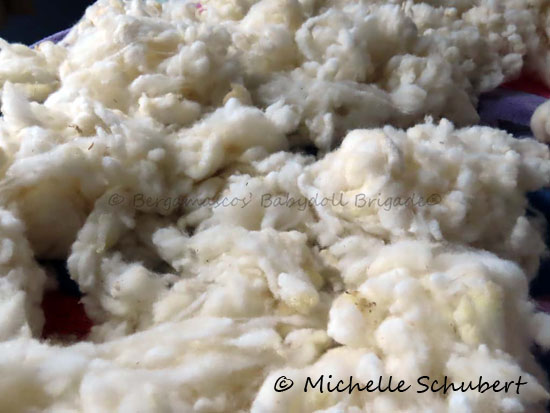
After Power Scour & rinse 2x
6. Drying - Lay out a couple of towels and put the wool on it. Roll it up into a tube, and then step on it to absorb water. Afterwards, I lay it out to dry. I put it near the HVAC vents, or under a ceiling fan, which helps it to dry faster. I don't like putting mine outside but you may. Once it is dry, it is ready for the next processes. The process will vary depending upon what you're planning to do with the clean wool.
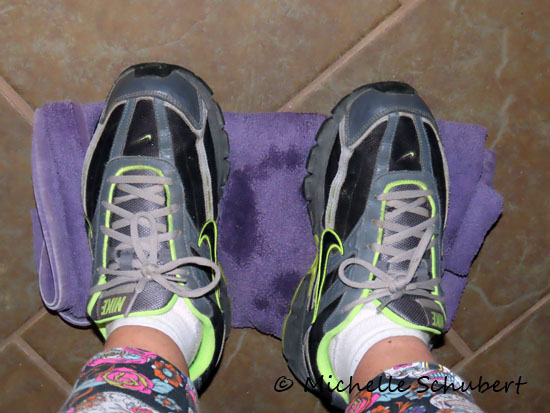
Wet wool rolled into a towel & stomped on
7. Picking - I use a Fancy Kitty Studio Bench Wool Picker which separates the fibers and removes more VM.
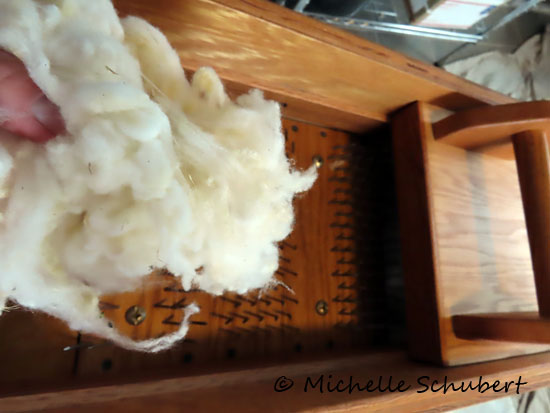
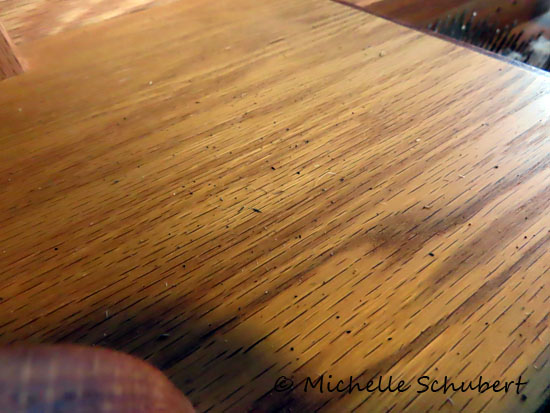
Fancy Kitty Box Picker / Some more VM removed after picking
8. After picking, I put the fleece back into the tumbler for another 60 minutes. Then I card it.
9. Carding - I use an original Patrick Green SuperCard (now made by Brother) to card my wool to makes batts & roving. Batts can be separated using the "Z" pull technique which basically give you roving. Or, diz the roving off the drum carder.
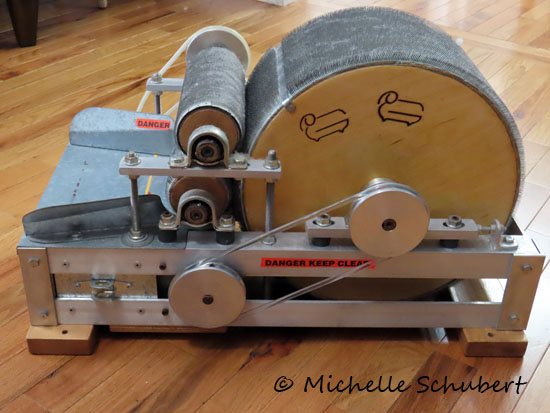
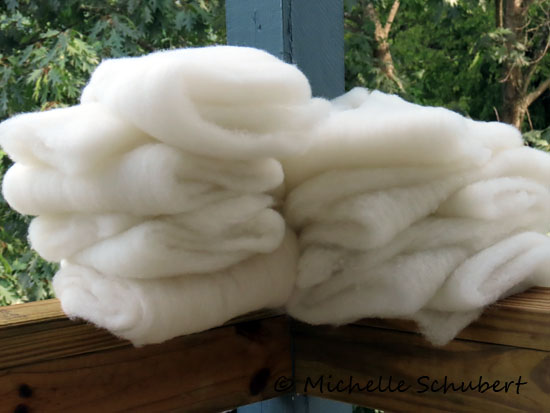
Patrick Green SuperCard / Batts made using the drum carder
10. Spinning - I use a Roberta Electronic Hand Spinner.
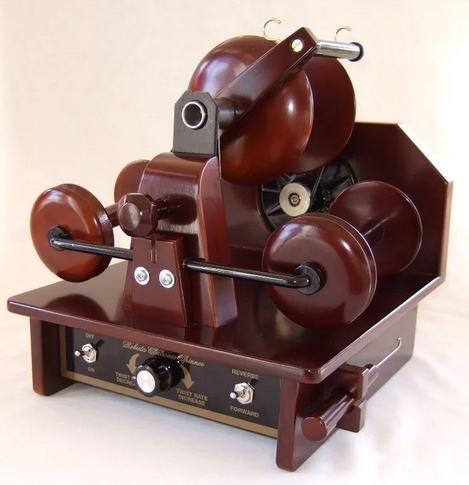
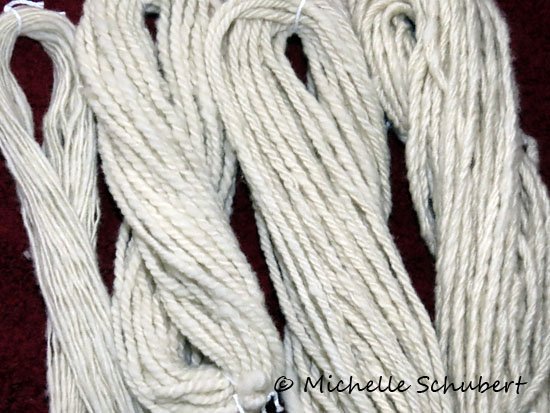
Robert Electronic Hand Spinner / Yarn spun on my Roberta - single, 2-ply from 1 single, 3-ply from 1 single (chain ply); & 4-ply from two 2-plies (cable),
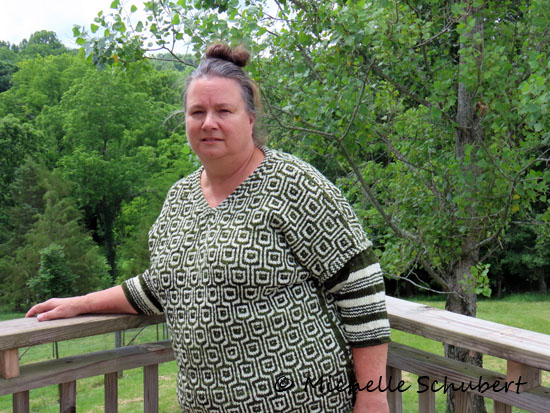
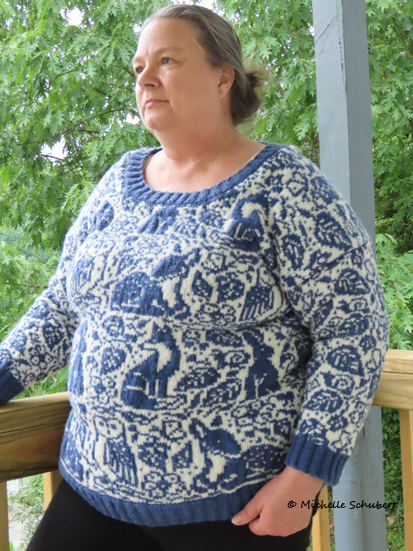
Sweaters I knitted using the Baldwin fleece I processed
This is how I
process Babydoll fleece from sheep to sweater. What works for
me
may not be what works for you. Research, experiment.
Most importantly, HAVE FUN! I've used the yarn I've
made to make hundreds of wearable itmes, as well as blankets and
afghans, and many household items such as baskets and hot pads.
Batts can be used in quilts too. Babydoll fiber is
"Wonderfully Versatile, Surprisingly Different".

